

Understanding RTP and Randomness
People playing 918Kiss may encounter terms such as RTP, RNG, house edge and volatility. These are general casino-game concepts, but their meaning is often misunderstood.
This page explains those concepts for educational purposes. It does not describe or confirm the internal operation, RTP settings, RNG implementation or testing status of 918Kiss or any particular game available through it. Most importantly, RTP does not predict a player’s result or provide a way to guarantee a win.
RTP in simple terms
RTP stands for return to player. It is a theoretical percentage built into a game’s mathematical design. The percentage describes how much of all money wagered the game is designed to return as prizes over the long run.
The basic formula is:
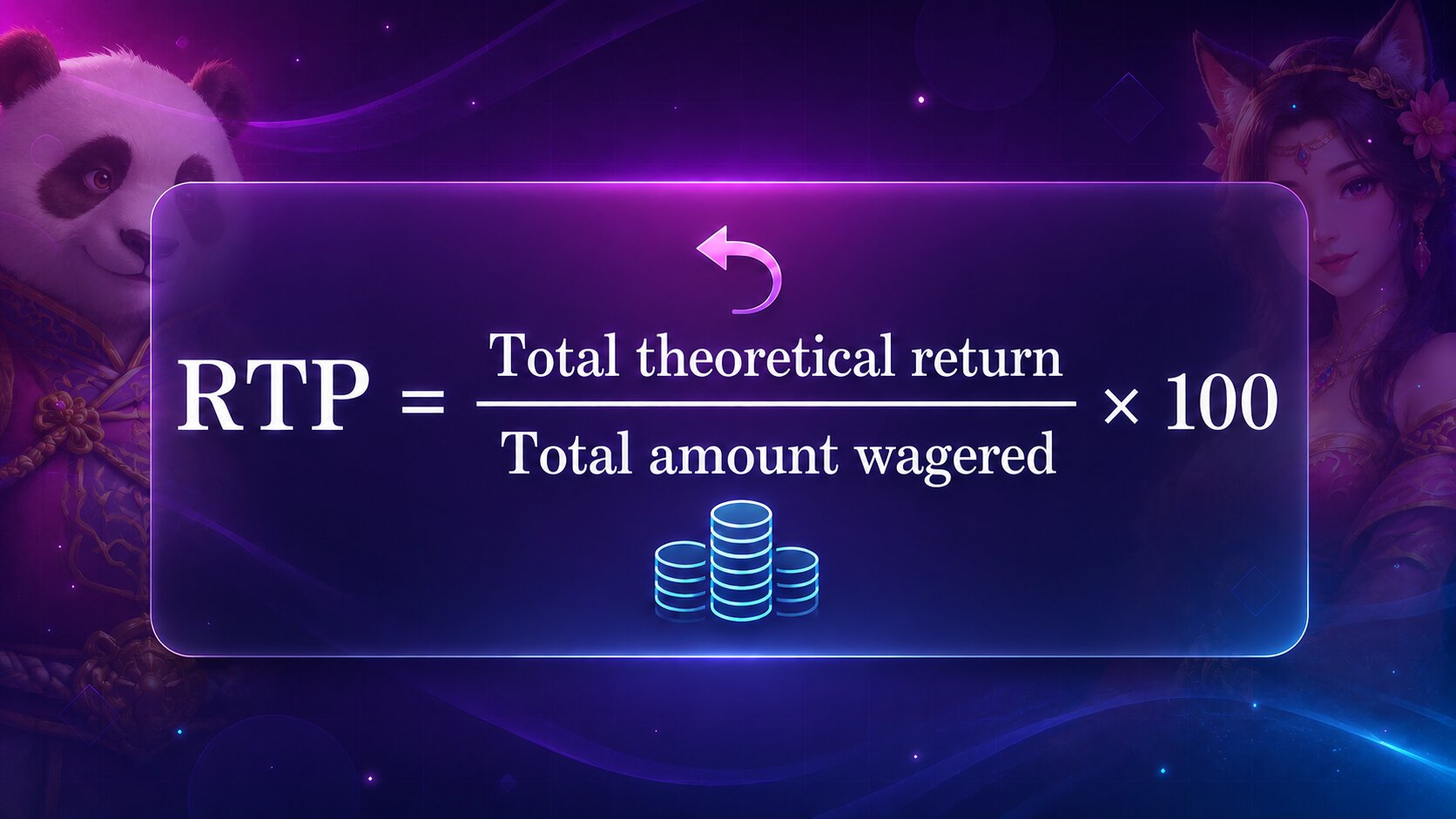
Imagine a purely hypothetical game with a 96% RTP. If RM100,000 were wagered across a sufficiently large sample, its mathematical model would correspond to RM96,000 being returned as prizes. The remaining 4% would represent the theoretical house edge.
That does not mean someone who wagers RM100 should expect to receive RM96. The calculation covers total wagering across many rounds and players. Individual results can be much higher or lower.
The 96% figure is only a mathematical example. It is not a stated RTP for 918Kiss, its platform or any game associated with it.
RTP and house edge
RTP and house edge express the same mathematical relationship from opposite sides:
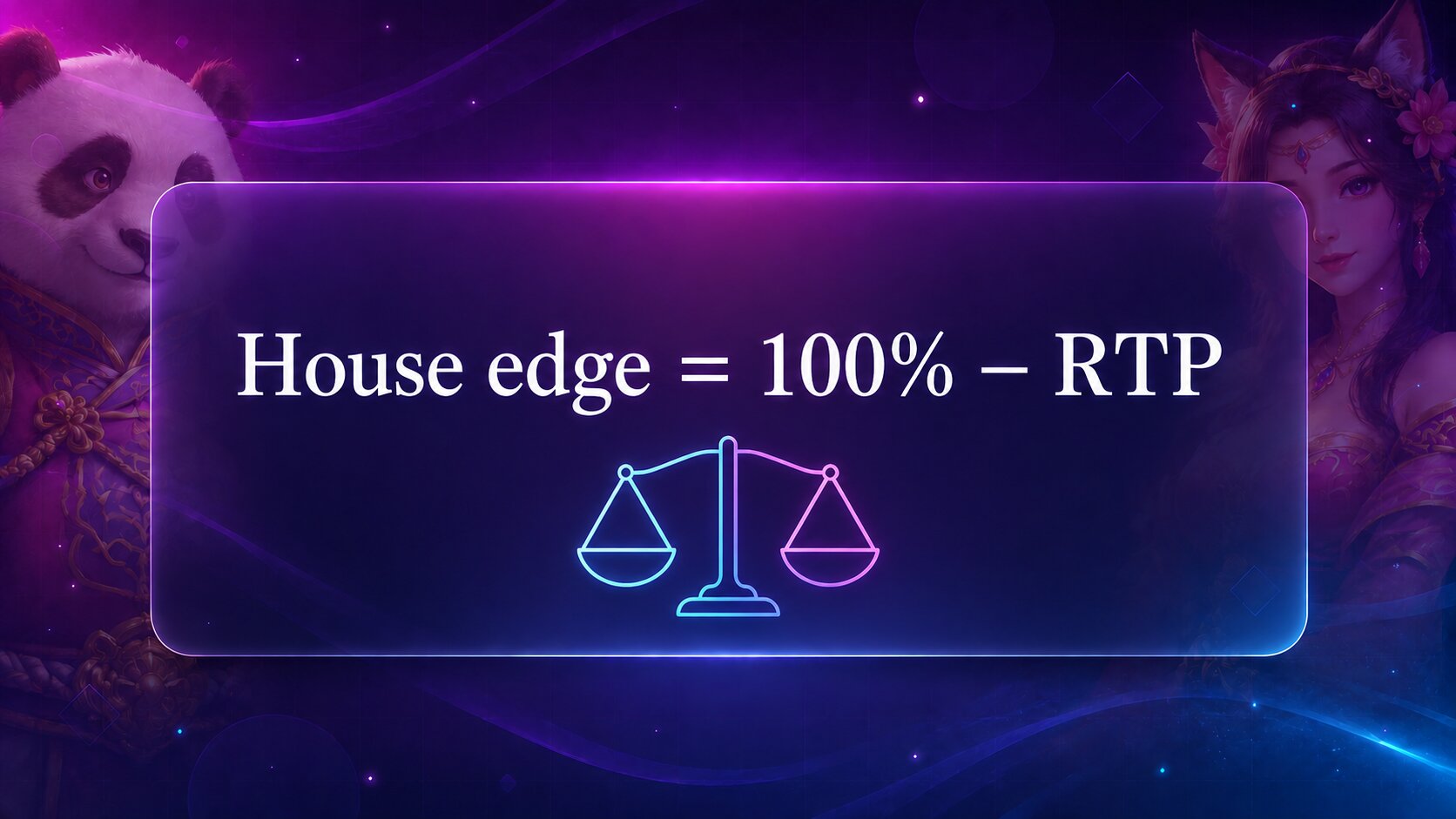
If a game has a theoretical RTP of 96%, its theoretical house edge is 4%. This does not mean the game deducts exactly RM4 whenever RM100 is wagered. A player might win, lose or finish close to even during a particular session.
House edge becomes meaningful across repeated wagering. Money returned as a prize may be wagered again, so the total amount wagered can become much larger than the original deposit. For example, placing ten RM10 bets creates RM100 in total wagering even if some of those bets were funded by earlier returns.
This is why session length matters. More rounds mean more money passes through the game’s mathematical model. A higher RTP may indicate a smaller theoretical house edge, but it does not turn gambling into a profitable investment.
How an RNG generally works
RNG stands for random number generator. In a typical RNG-based digital casino game, an RNG produces values that the game uses to determine results. The game’s rules then map those values to symbols, cards, numbers or other outcomes.
A simplified, general example looks like this. It is not a diagram of 918Kiss software or infrastructure:
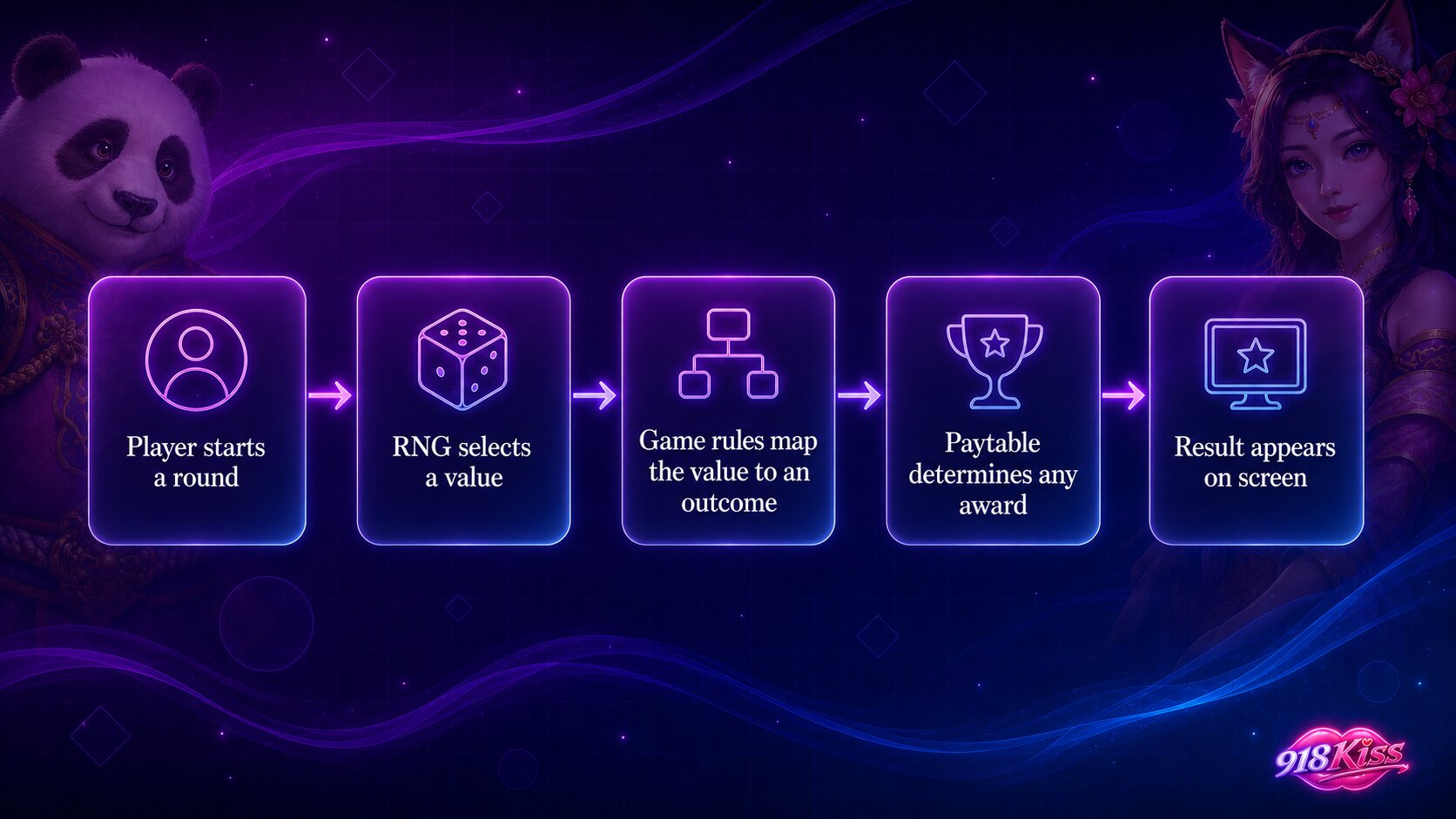
In this general model, the RNG and RTP have different jobs. The RNG is involved in selecting a result. The paytable, prize probabilities and other rules form the mathematical model that determines theoretical return.
An RNG therefore does not create an equal chance of every possible prize. Some results can be deliberately rarer than others. Random selection still operates within the probabilities and rules designed for that game.
Why previous results should not be treated as predictions
Under the general mathematical concept of independent random rounds, the result of one round does not make a particular result more likely on the next round. This principle explains how independent outcomes are supposed to work; it is not a claim about the technical implementation of a particular 918Kiss game.
Random sequences often contain streaks and clusters. Several losses in a row can occur without changing the probability of the next result. Several wins can also occur without making a game “hot.” A visible pattern in recent results is not necessarily a useful prediction.
| Common belief | What it means in practice |
|---|---|
| “I have lost ten times, so a win is due.” | Earlier losses do not create a debt that the next round must repay. |
| “This game is hot right now.” | A recent winning sequence does not establish a future advantage. |
| “Games pay more at certain times.” | The time of day alone does not show that the odds have changed. |
| “A bigger bet improves the RNG.” | Bet size may change prize values or feature eligibility, but it does not make a winning result due. |
| “This winning screenshot proves the RTP.” | One result cannot demonstrate a game’s long-run theoretical return. |
Switching devices, leaving and reopening a game, or changing the size of a bet should not be treated as a reliable method for predicting an outcome or guaranteeing a win.
RTP, volatility and hit frequency are different
Two games can have the same RTP and still feel completely different to play. RTP describes the overall theoretical return, but it does not explain how that return is distributed.
Volatility, sometimes called variance, describes how widely results may fluctuate. A lower-volatility game generally concentrates more of its return in smaller, more frequent prizes. A higher-volatility game may produce longer stretches with little returned and place more of its return in less frequent, larger prizes.
Hit frequency describes how often a result counted as a win occurs. It should not be confused with the chance of finishing a session in profit. A small prize can be less than the amount wagered on that round while still being displayed as a winning result.
Other details also shape the playing experience:
- The maximum possible prize
- The distribution of small and large prizes
- The number of paylines or ways to win
- Bonus-feature rules and eligibility
- Jackpot contributions
- The minimum and maximum stake
- The speed at which rounds can be played
A game with frequent small prizes may feel active without having a higher RTP. Another game may award prizes less often but reserve more of its theoretical return for rare outcomes. Neither pattern predicts what a particular player will receive.
Does randomness alone prove that a game is fair?
No. Randomness is only one part of evaluating a digital casino game. A complete assessment would also need to consider the game’s mathematical rules, the software version in use and whether any tested software matches the version available to players.
It helps to separate several questions:
- Does the RNG produce unpredictable results?
- Does the game apply its stated paytable correctly?
- Does the displayed RTP match the active configuration?
- Is the tested game version the same one being offered?
- Are account balances and transactions handled correctly?
- Are the game rules clear and accessible?
Testing one component does not automatically answer all of the others. RNG testing, for example, does not assess withdrawals, customer support, promotions or account security.
What meaningful game testing would identify
As a general principle, independent testing is most useful when the report clearly identifies what was examined. A logo or general statement provides little context on its own. This checklist explains what a detailed record would normally need; it does not state that 918Kiss or any related game has undergone such testing.
A meaningful record should identify details such as:
- The testing laboratory
- A report or certificate number
- The client or product examined
- The exact game title and game identifier
- The game and RNG software versions
- The build identifier or digital signature
- The tested RTP configuration
- The testing date
- The technical standard applied
- The platforms or channels covered
Version matching matters because games with the same or similar names may have different providers, configurations or builds. Information about one version should not automatically be applied to another.
Can you calculate RTP from your own results?
You can calculate the return from a session, but that is not the same as establishing a game’s theoretical RTP.
The calculation for your observed session return is:
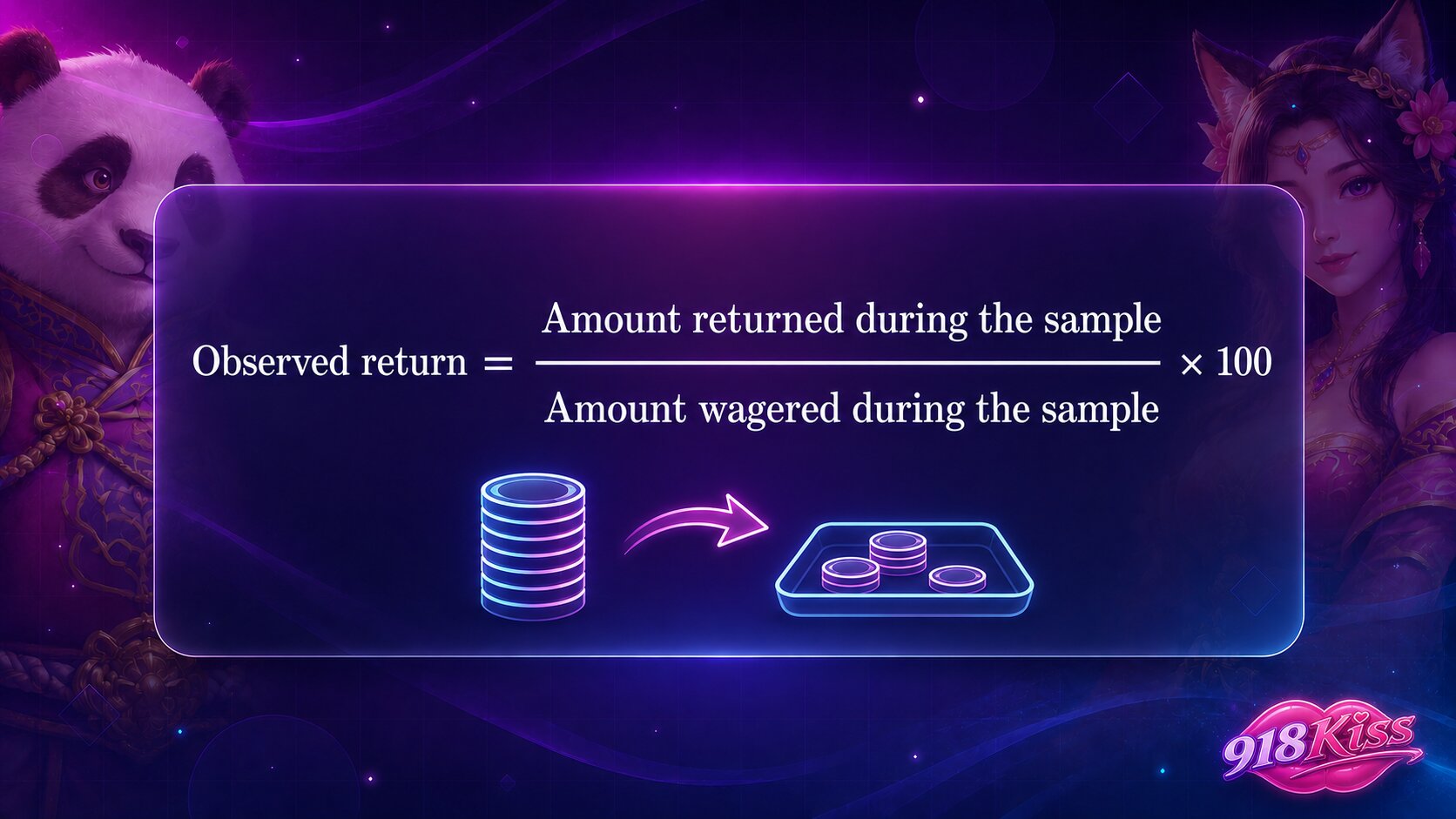
Suppose you wager RM200 in total and receive RM150 back in prizes. Your observed session return is 75%. That number describes only the recorded session. It does not prove that the game’s theoretical RTP is 75%.
A short sample can differ greatly from the underlying mathematical expectation. Even a larger personal record cannot confirm how the software was built or configured. Establishing theoretical RTP requires information about the game model; assessing the RNG requires technical testing.
Do not spend money simply to generate a larger sample. Recording more rounds increases financial exposure and still does not turn personal results into certification.
How to read RTP information when it is available
If a digital game provides a help, information or rules screen, read it before placing a bet. The exact layout differs by title, and not every interface presents the same information. Useful details may include:
- The RTP disclosure
- The paytable
- The provider or copyright name
- The game title, identifier or version
- The number of paylines or ways to win
- The total bet per round
- Bonus-feature requirements
- Jackpot contribution rules
- Maximum-prize conditions
Read the full context around any published percentage. Check whether it applies to the base game, includes bonus features or jackpots, or changes with a selected configuration. A copied number without the game identity and rules can be misleading. Do not assume that an RTP reported for a similarly named game elsewhere applies to a game associated with 918Kiss.
Also check the total stake rather than focusing only on the value assigned to one line, credit or component of the bet. Faster rounds and repeated wagering can increase total spending more quickly than expected.
What RTP should change about your decisions
RTP is useful for understanding the mathematical cost of a game, but it cannot tell you when to play or when a win will occur. Even a game with a comparatively high RTP can produce a complete loss during an individual session.
Before playing:
- Decide on a fixed spending limit.
- Treat that amount as entertainment spending, not an investment.
- Check the total bet and round speed.
- Do not increase the stake because a win feels due.
- Do not chase money already lost.
- Stop when your planned money or time limit is reached.
Only gamble if you are legally permitted to do so in your location and meet the applicable age requirement. If gambling stops feeling controlled or enjoyable, take a break and seek support from an appropriate local service.
The main point to remember
In general casino-game terminology, RTP describes a theoretical long-run return. Randomness concerns how individual outcomes are selected. Volatility and hit frequency concern how results may be distributed and experienced.
This article explains the concepts; it does not confirm that 918Kiss follows a particular model or uses any stated percentage. None of these concepts predicts a player’s next result or guarantees a win. Treat any platform- or game-specific RTP figure separately and consider only information that clearly identifies the exact game and version.